
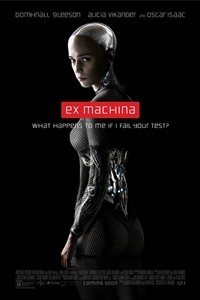
 Ex Machina
Director: Alex Garland
Starring: Oscar Isaac, Domhnall Gleeson, and Alicia Vikander
108 Minutes
Rated R
Ava is a robot with exceptional artificial intelligence. She is beautiful, intelligent, emotional, affected, and curious. She is also the trapped subject of scientific analysis, the caged bird that when released will change everything about the world that we know. Good science fiction always asks difficult questions, most of the time without an easy to explain answer. While the structure of science fiction films can become overwhelmed by special effects and unnecessary spectacle, these films are still completely amusing in ways that similar films, like action films, are not. It’s the fascination with theory and how well a sci-fi film can support a hypothesis. Director Alex Garland builds a methodical structure with an intelligent narrative, one that focuses on relationships between men and women, the advancing world and how it connects with progressing technology, and the trappings and limitations of science. “Ex Machina” is a welcome addition to the list of exceptional science fiction films.
Nathan (Oscar Isaac) is a reclusive mogul who invented the world’s foremost search engine. Caleb (Domhnall Gleeson) is a programmer who wins an invitation to meet and work with Nathan on his private research compound. After being dropped off by a helicopter and venturing through a forest, Caleb arrives at a door and is greeted by a computer. Once inside Caleb meets with the egocentric Nathan who discusses all aspects of science, religion, and art with Caleb. These discussions are all in preparation for Caleb to meet Ava (Alicia Vikander), a robot whose fabricated skeleton is accommodated by a human face. Caleb is to conduct a test to determine whether he can identify Ava as a computer. Ava is intrigued by the new visitor and begins to conduct her own tests on Caleb.
Alex Garland wrote and directed the film; his measured pacing in the script shapes and molds some great scenes of tension but also surprisingly some touching emotional moments. The characters are constantly changing, affected by the people and situations around them. Whether Ava who continually learns and adapts, Caleb who is pulled into different allegiances, or Nathan who is constantly embattled by his own intelligence and isolation, Garland exhibits a keen eye for character development and utilizes all these elements to make the narrative mysterious, suspenseful, sad, and insightful. Garland also uses the characters to to ask important questions that add depth to the story but are also simply offered to spark the viewers own reasoning. It's what good writing should do.
While the film doesn’t lean on special effects, it does utilize it in nearly every scene with Ava. The composition of her robot and human attributes are outstandingly rendered and intricately constructed, this deign is also used to provide depth to the character. Ava’s body is fashioned with a metallic mesh but her face, hands, and feet are covered with skin. This allows the character to portray emotion through her face, express feelings of anger and tenderness with her hands, and show direction and motivation with her feet. It’s a well-conceived design that contributes to the ambiguous objectives that Ava presents as the film progresses. Actress Alicia Vikander gives a confident and sensitive portrayal as Ava, a true breakout performance.
Oscar Isaac is terrific as the ego-driven inventor Nathan, who is always gleefully a step ahead of everyone. Isaac does the best work when Nathan’s weaknesses overcome him, moments that lead to dancing and intellectual sparing matches with Caleb and sometimes himself. Domhnall Gleeson is also good as Caleb. Whether his fanboy-like admiration of Nathan or his easily manipulated emotional attachment to Ava, Gleeson does a great job of transitioning from susceptibly trusting to questioningly suspicious.
Alex Garland, who started his career as a novelist and screenwriter, makes an impressive directorial debut. “Ex Machina” is an exceptional film on many levels, but perhaps the most admirable quality exists in the questions it proposes and the answers it allows the viewer to contemplate.
Monte’s Rating
4.50 out of 5.00
 The Age of Adaline
 Clouds of Sils Maria
 True Story
 Unfriended
 He’s in Phoenix not just for his screenwriting, though: he’s directed his first film, Danny Collins, from a script he wrote, and the film kicked off the annual festival. I caught up with him to chat about the film just 30 minutes before Danny Collins’ Phoenix premiere.
 The Longest Ride
 Insurgent
 '71
'71
 Cinderella
 The Salvation
 Champs
 The Second Best Exotic Marigold Hotel
 Chappie
 Double Indemnity — Insurance salesman Walter Neff has killed a man, staged his death and is now planning on running away with the man’s girl. But as he walks home, he’s startled by his ears: “I couldn't hear my own footsteps. It was the walk of a dead man.” With Raymond Chandler’s brutal dialogue, Billy Wilder’s pinpoint-precision directing, and the white-hot chemistry of Fred MacMurray and Barbara Stanwyck, Double Indemnity embodies all that was great about noir in the 1940s.
 noir classics that rely on gullible men and seductive women. The man here is William Hurt, playing a greasy lawyer, and the woman is Kathleen Turner, the trophy wife to a rich executive. They conspire to kill her husband, but then everything falls apart, like Walter Neff before them. The lighting is gorgeous, the sex scenes are legitimately sexy, and the Turner’s hroaty purr is just perfect for this material.
 Touch of Evil — When people talk about Touch of Evil, they often talk about the brilliant three-minute-plus tracking shot that opens the movie. It’s a masterpiece as far as long takes go, but so many discussions end there, long before the heart of this gorgeous film has been unearthed. Of course, the film is also steeped in lore, with director Orson Welles fighting, and losing — and then many year after his death, winning — for final cut of the film. Today, with Welles’ cut, the film is noir legend, from its shadowy interiors and brazen dialogue to its cynical worldview and devastating conclusion.
 Douglas is great, playing a cop who is blinded by his lust.
 Focus
Director: Glenn Ficarra and John Requa
Focus
Director: Glenn Ficarra and John Requa Mommy
Mommy
 The Lazarus Effect
 1- The Assassination of Jesse James by the Coward Robert Ford — Andrew Dominik’s gorgeous ode to the west’s greatest outlaw is unlike any western that came before it. Rapturously narrated, photographed in poetic stanzas, and with acting that is devastatingly pure, Jesse James established the myth of the man and then shattered it, only to mythologize once again in its closing heartbreaking chapters.
 the Old West and its historical relevance. In Open Range he focuses on several cowpunchers and their desperate fight with a town’s heavy-handed leader. The film is notable for its realism, with gunfights taking place in agonizing realtime, townspeople who don’t vanish at high noon and relationships that don’t just take place behind swinging saloon doors. Dances With Wolves might be masterpiece, but Open Range is Costner’s smaller study of the west.
 6-Brokeback Mountain — Forever known as the gay cowboy movie, people often forget that Ang Lee’s Brokeback Mountain was a loud declaration of the western’s right to be anything it wanted, without all the white hat/black hat cliché. The film made homesexuality, cowboys, stereotypes of the Old West, hate crimes, family values … all of it relevant in a modern context. Step aside from the cultural response to Brokeback Mountain and peer into this film’s open heart and you’ll see that had a lot to say, all of it eloquent.
 Part revenge tale, part rescue mission, but thoroughly a Tarantino picture, Django turned two men — one white and one black — loose to fight their way through the Antebellum South. By recognizing and commenting on America’s terrible shame the film committed itself to western history.
 10-Appaloosa — Ed Harris’ forgotten cowboy flick does not break tons of new ground for the western genre, which is why I like the movie so much — it’s more of a callback to the way these movies used to be. Lawmen with big guns, cattle barons, outlaws, shootouts, main street confrontations … innovation in the genre can only go so far before it must reach back into the past and borrow from what already works. And there is nothing wrong with that.