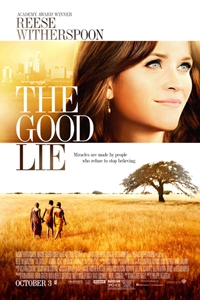
The Good Lie - Movie Review by Eric Forthun

The Good LieThe Good Lie  

Starring Reese Witherspoon, Arnold Oceng, Ger Duany, Emmanuel Jal, Corey Stoll, and Kuoth Wiel

Directed by Philippe Falardeau


Rated PG-13

Run Time: 110 minutes

Genre: Drama


Opens October 3rd


By Eric Forthun of Cinematic Shadows


The Good Lie comes from the producer of The Blind Side, a similarly themed film focusing on an African-American football player from a troubled home going under the wing of a wealthy white woman. It was a tale that won Sandra Bullock an Oscar and made over $300 million worldwide, but it was ultimately a film about Bullock's character rather than a story that appropriately tackled race. The Good Lie becomes its own specimen of socially aware film, one driven by emotional power and independently-minded storytelling that makes it a special breed of major motion picture (particularly when it's advertised star Reese Witherspoon is non-existent for much of the film). Centering on the "Lost Boys of Sudan," the story starts in Sudan in the 1980s and focuses on a group of youngsters: Mamere (Arnold Oceng), Jeremiah (Ger Duany), Paul (Emmanuel Jal), Mamere's sister Abital (Kuoth Wiel), and Mamere's brother Theo (Femi Oguns). Facing the turmoil of a civil war in their home, they flee the country and aim to find refuge in a less volatile place.


Theo surrenders himself to armed militants to save the others' lives, so their trip takes them to a bordering country where they find hospice in a refugee camp. The first thirty minutes of the film is almost entirely subtitled and tells a harrowing story that feels too devastating to be fiction. That's because the film is based on the true story of these boys (and girl) and their journey to America, which doesn't happen until roughly ten years after their arrival in the camps. When they arrive in the United States, Abital gets separated and sent to Kansas City while the boys head to Boston, so they make it a mission to get her back. They are so hopelessly unfamiliar with everything that Americans have: they do not know what a running toilet is, they do not recognize why people throw away old food in the grocery store, and they do not understand formalities that Americans exchange when they don't mean something.


They are put under the supervision of Carrie Davis (Reese Witherspoon), a woman who helps people like Mamere and folk find jobs upon relocation. Carrie is an untidy, unhappy woman that has lost people close to her and doesn't connect herself with many around her, but there is something that strikes a spark in her about these boys. So she takes them under her wing and aims to guide them through their transition while giving them a sense of family that they lost a long time ago. The film casts itself in the aftermath of 9/11, allowing the story to comment on the struggle of travel and transportation at the time and the stagnation of the refugee program. While using that backdrop, it shows the different struggles each person faces upon their arrival: Paul is efficient at building things but falls into a web of drugs in his workplace; Mamere works at a grocery store but wants to get his sister and brother to Boston; and Jeremiah faces an issue of losing his ethnic identity in his workplace.


It's rare to see a studio film as politically charged and character driven as The Good Lie, which goes along with how refreshing and authentic everything within it feels. There's a sentimentality and kindness to its approach and the way it explores these Sudanese characters over any others; Witherspoon is an advertising piece that is good but not even close to the focal point of the story. The casting of actual Sudanese refugees makes the story feel lively and true to its nature. Philippe Falardeau's direction excels in delicacy and substance, even if there are very few moments that ring inauthentic; those few feel as if they are mocking the central characters and their obliviousness to the new world, but that might be the fish-out-of-water component. Mamere's story works wonders when, in its final moments, it explores the ways of American privilege and how it can be reversed and presented in a new, unforgettable way. The Good Lie skims the surface of the Sudanese refugees' hardships, but tells a good-natured, heartwarming story with compassion.
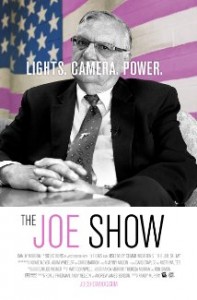
The Joe Show - Movie Review by Michael Clawson

Joe Show 2The Joe Show  

Directed by Randy Murray

Rated NR


Run Time: 100 minutes

Genre: Documentary


Opens October 3rd


by Michael Clawson of Terminal Volume


The Joe Show begins with a moment so surreal, it’s simply hard to believe: Maricopa County Sheriff Joe Arpaio singing — quite badly — Frank Sinatra’s “My Way.” This is both a sad joke and an ironic truth about Arpaio’s iron grip on Arizona’s law enforcement.


Arpaio, who called himself “America’s toughest sheriff” so much that it actually came true, is the star of Randy Murray’s fascinatingly frank documentary about how Sheriff Joe, a name that has become shorthand for Arizona’s wacky politics, is the most hated/loved figure in the Southwest. His fans adore him, and his critics call him a cancerous void. He could care less what he is, as long as a news crew is there to film his reaction.


Murray’s film starts by pitching underhanded softballs right over the plate, and Arpaio clobbers them out of the park. Sheriff Joe does his Sinatra song, cooks pasta in his kitchen with his wife, and then as he shuffles around his downtown office, which has a locked closet lined with DVDs and VHS tapes of all his media appearances, which he hordes in his vault of drywall and fluorescent lighting. The beginning of the film is so non-threatening and mundane that it feels like more Arpaio fluff — part of the neverending Sheriff Joe PR machine. But then the knives come out, and The Joe Show eviscerates this bewildering Arizonan figure.


In an early scene, Arpaio parades prisoners around in pink underwear and handcuffs — Maricopa County’s fetish of choice — as way to drum up press for his new “tent city,” a canvas oasis where Arpaio sends low-level offenders for the benefit of the evening news and his own ego. Joe glows in front of the cameras as he bellows and bloviates to a group of time-robbed reporters and the bouquet of foamy microphones they’re offering as virgin sacrifice to that evening’s soundbite. And yes, that’s a handgun-shaped pin on his tie.


His humiliating treatment of prisoners provides a nice jumping-off point to many of his other political stunts: the foolhardy Obama birth certificate investigation, his harassment of the city of Guadalupe, bogus corruption charges against county officials, the arrest of New Times editors … the list never seems to end. Arpaio often speaks for himself, and is brutally honest about his intentions — there’s no such thing as bad press, except no press, or when someone spells Arpaio wrong. His gold-ol’-boy schtick is amended and tweaked by bobbleheaded PR juggernaut Lisa Allen, who seems like a lonely person. Without Joe will she just evaporate into oblivion?


In case it’s not clear, I’m not a fan of Sheriff Joe. I worked for a newspaper that was in his sights for many years. When we didn’t cover what he wanted, he retaliated by shutting the paper out of public events. Then press reports stopped coming. And then public records requests were ignored. Eventually the paper sued him, and won. He appealed, and we won that, too. For many years after, I would see Arpaio at media events and when he saw the logo on the press badge he would snarl and growl. Literally.


A lot of what Arpaio does is harmless cornball politics. Pink underwear and green bologna make for fun headlines, and for the most part the public just shrugs its shoulders. But The Joe Show doesn’t stop there. It pokes and prods deeper into the stuff that makes even Arpaio fans queasy: the violent deaths of inmates at his jails, including Scott Norberg, whose death was covered up amid disappearing evidence; racial profiling of basically anyone that wasn’t as pinkish white as Arpaio; his “culture of corruption,” from dopey henchmen like Paul Chagolla and Dave Hendershott all the way down to deputies and jail guards; and the failure to investigate more than 400 sex crimes. That last one should have lost him his last election, but even raped teens couldn’t stop the Arpaio media blitz.


The film features interviews from some of the most important figures in the Arpaio story — with lots of Arpaio himself and Allen, who does a wicked Jane Fonda impression — including one supporter who says she’s not a racist, but then says that “Mexicans haven’t evolved.” One of the interview highlights comes from interviewer Larry King, who states plainly, “Villains make good guests because they don’t think they’re villains.” The film presents both cases, pro-Arpaio and anti, but it’s hard not to question Arpaio’s police work when the film frames the sheriff as a media-hungry fame-monster who will do anything to be on TV. And that’s not necessarily a description he would disagree with. Although it skews against Arpaio, Joe Show will have its cheering section as its star casts himself as Arizona’s savior from Obama, Mexicans, criminals and “the media.”


Sheriff Joe will go down in Arizona history as an antiquated old fart who was tired of kids on his lawn and Mexicans in his grocery store, but his simplistic view of politics, government and police work will be his ultimate legacy. As much as Joe fancies himself a sheriff, a jailer and the county’s top cop, he’s little more than a movie star with a badge. And The Joe Show is his blockbuster.

The Joe Show - Movie Review by Eric Forthun

Joe Show 2The Joe Show  

Directed by Randy Murray

Rated NR


Run Time: 100 minutes

Genre: Documentary


Opens October 3rd


By Eric Forthun of Cinematic Shadows


The Joe Show paints a glowingly American portrait of a self-made Arizona icon. Joe Arpaio is the most famous Sheriff in the country because he so uniquely crafts his own public image, whether that be through staged news stories or over-the-top, headline-worthy arrests. The man is divisive and split heavily across partisan lines, so it’s fitting that the conservative public figure (not politician, mind you, as Joe himself consistently points out) resides in a conservatively-minded place like Maricopa County, Arizona. He’s gained headlines over the years for countless, “shocking” actions, like forcing the inmates in Tent City to wear pink or creating the first (once again, self-proclaimed) female chain gang. Arpaio is a perfect example of a man that the media elevated to godly levels, so what more could a documentary on such a divine subject tell us?


Apparently a lot more, as Randy Murray’s documentary examines the inner workings and unavoidable corruption behind the sheriff and his county’s actions over the past twenty years while he’s been in power. Arpaio’s support over the years at the polls has slowly dwindled, but when he was in his prime he was a man with swagger and unrivaled conviction. Even his naysayers could not deny the confidence with which he has resided over the county, since he assumed a position that most other sheriffs would not take to heart as Arpaio did. He cracked down on drugs and fought for persecution of illegal immigrants, even if that meant violating certain rights under the jurisdiction of the law. One example showcases the county’s misuse of power in Mesa to scare a city leader that disagreed with Arpaio, while another centers on the war that escalated between his county and the Phoenix New Times.


That one in particular focuses on, what the film claims, the largest issued subpeona in American history, with millions of IP addresses being requested to further exemplify the county’s reach in power. Arpaio increasingly becomes belittled and persecuted as the documentary progresses, with the beginning setting up a calm before the attacking storm rains on Arpaio’s tent-filled parade. The film casts a light on his personal life and examines the titular man through a variety of lenses: as a family man, a politician, a media-hound, a lawbreaker, and a stick-to-his-guns leader. Arpaio has millions of supporters around the nation, ranging from a woman in Arizona who does the classic “I’m not a racist, but…[insert racist opinion]” to gun-toting Ted Nugent. For every person that seems to defend him, another chimes in to comment on his relentlessly aggressive police force that abuses power and commits racist actions.


The Joe Show grows into an indictment of the Arizona sheriff and should satisfy opponents of the man while leaving supporters a bit cold. The attempt at examining Arpaio through many lenses creates an uneven, far-reaching portrait of a highly complex man, one with a rich personal history and a fascinating political narrative. I fall on the side that doesn’t support Arpaio, mostly for the reasons that are emphasized in the film’s second half. The recklessness and abandonment of civil rights in multiple cases by the county sheriff’s office leads to a bad taste in many voters’ mouths. But Joe Arpaio is the man, the myth, and the legend: his image is on every television screen every week because he wants to communicate as emphatically as possible that he is the World’s Toughest Sheriff. Randy Murray’s documentary is invasive, biting, and ambitious, even if that amounts to an uneven but entertaining character study.

Left Behind - Movie Review by Eric Forthun

Left BehindLeft Behind  

Starring Nicolas Cage, Chad Michael Murray, Cassi Thomson, Nicky Whelan, Jordin Sparks, and Lea Thompson

Directed by Vic Armstrong


Rated PG-13

Run Time: 105 minutes

Genre: Action/Thriller


Opens October 3rd


By Eric Forthun of Cinematic Shadows


Left Behind is an absurdly moronic B-movie that confuses itself as a disaster film from the 1970s while wanting to be a serious moral tale of spirituality. The cast features a mish-mash of stars reaching at the opportunity for an easy check, ranging from Nicolas Cage and his ever-evolving hair line to Chad Michael Murray’s confused, “When can One Tree Hill return?” self. The story is the first directorial effort from Vic Armstrong, who can legitimately only be described as one of the greatest stunt workers to ever work in the business. He’s made things explode beautifully in a hefty amount of blockbusters over the last thirty years, including an undisclosed credit for the opening scene in Terminator 2: Judgment Day. The man deserves respect and, more importantly, he deserves a script with more competence and respect for its subject than this one. It’s a hilariously offensive bundle of ineptitude.


The story begins with Chloe Steele (Cassi Thomson), an atheist that grew up with a religious mother, Irene (Lea Thompson), and an absent, cheating pilot of a father, Rayford (Nicolas Cage). Chloe wanders through the airport one day to stop her father from flying away when they were supposed to spend time together as a family. Rayford wants to take an excursion in London with the sexy flight attendant Hattie (Nicky Whelan), a character that acts not only as the ditzy blonde but also as the helpless love interest with no ability to sustain herself. Chloe also runs into Buck Williams (Chad Michael Murray), a famous media person that might be an investigative journalist or a reporter on the news or someone important. I don’t know. All I know is that he has a book and a religious woman asks him some questions until Chloe interrupts by attacking her beliefs. So naturally Buck and Chloe bond by getting along in the airport and hopping to each other’s tables like a long-lost romantic couple.


So now that we are past the first fifteen minutes of the film (yes, all of that happens in such a brief amount of time), the story progresses to the flight happening and the Rapture ensuing, taking millions of people around the world off of the Earth and into Heaven. What becomes so grating about the film’s rushed exploration of the Rapture is how idiotic the remaining population becomes, particularly as the religious become prophets in memory while the non-religious become aggressively dumb and incompetent. The only way these ideas are communicated furthers the film’s growing annoyance: every character delivers a monologue in virtually every scene, with the only back-and-forth conversation happening in the film’s opening moments. There’s no sense of ebb-and-flow within the film as much as there is a scream point-scream other point dynamic. Cheap filmmaking really begins to hurt the quality of a film’s message, and Left Behind encapsulates that.


Nicolas Cage gives a committed performance considering that his character must move through asinine developments. He unravels monologues in the film’s middle act that oddly avoids the use of the word “Rapture,” almost as if the film wants to move away from its religious upbringings. And that’s another important reason the film doesn’t work, outside of its hilariously awful plot movement: it doesn’t embrace the Christian elements of its story and instead makes martyrs out of the religious and tells the story of the doubters. The characters aren’t given a semblance of development and the story intersperses characterizations including but not limited to: an old lady who clearly has dementia but draws laughs from her sickness, a little person that apparently deserves to be kicked down a slide (it needs to be seen because that ACTUALLY HAPPENS), a woman wielding a gun on an airplane thinking other people stole her child, and more. All of these glorious moments can be found in Left Behind, the funniest, most woefully inept drama of the year.

The Good Lie interview by Eric Forthun

By Eric Forthun of Cinematic Shadows  

The Good Lie tells the story of the “Lost Boys of Sudan,” a group of Sudanese refugees that escaped the civil war in their native country to begin again in America. They faced hardships adapting to their new lives, particularly when one of the boys is separated from his sister when she is sent to another American city.


In the aftermath of 9/11, the refugee system came to a standstill. But refugees like Emmanuel Jal and Ger Duany, two of the film’s stars, made it to America and became successful after dealing with harrowing, heartbreaking circumstances as children.


Ger Duany commented on some of the most shocking things he encountered when he first arrived in America, remarking on a scene in the film The Good Liewhere a couple is making out in the airport while another man rides around on a motorized scooter. “I saw similar things, especially when I landed in New York City,” Duany said. He didn’t know people had the freedom to do such things. “People were all over and moving in a bunch of different directions. Where I come from, everyone moves in one direction and keeps going.”


The film’s producer, Molly Smith, understood the struggles they faced when they landed in the United States. “Given his age and height, they just put him [Duany] in ninth grade,” Smith remarked incredulously. “Based on his height and apparent age, even though he didn’t know any English.”


“I didn’t know anything the teacher was saying,” Duany added.


Emmanuel Jal furthered their story by telling of his first encounter with a toilet, something we take for granted. “This thing is probably connected to a river…what if a snake comes out? I would squat and look down in case I needed to grab the snake and kill it,” Jal joked. “And I was once given soap that smelled like pineapple, so I ate it thinking it was food.”


Jal grew up in Kenya and moved to Switzerland, learning about American culture from films like Rambo and television shows like Tom & Jerry. His perception of America was based on what he had seen in popular culture, even remembering how he had learned about angels and connected that with white people, whom he had never seen. “And then I realized that they are just like me.”


Smith recalled stumbling onto the film two and a half years ago and connected with its unique story. “Reese Witherspoon shows up 35 minutes into the film and it’s not even about her,” Smith said, “so I understand why the story scared people. But we fell in love with how beautiful it was and we were blown away…as long as you can find the right tonal balance, which was real, we could make something great.”


The director insisted that he would make the film with real Sudanese refugees, which took about six months through a worldwide casting search to find the right choices. “It was an uphill production, to say the least,” Smith asserted.


The film takes place on the backdrop of an extended civil war between north and south Sudan, which has been going on since at least 1947. “How can you condense the decades of civil war into a single script?” Duany asked. “That’s what shocked me…this is the focus of the movie, the little kids in a land with which they are unfamiliar.” He wants there to be a film made about Sudan that handles the turmoil the country has faced, but the story remains unique due to its emphasis on the children.


“Everyone should treat this film as an educational tool,” Duany added. “This is a story for everyone who walks with two feet on this earth.”


Jal continued that point, elaborating, “Some people may find their purpose. As human beings, we connect with each other, and every human being can empathize with pain. Every person, every color, especially women, can connect with a troubled child that can make a difference.”


One moment occurred in Nashville, Tennessee, when a 21-year old man was outside near Duany by himself. “He was a very intelligent guy who had different problems than mine. ‘Right now I only have $800 to my name and I have rent coming up, and I don’t know what I’m going to do for a job,’ the main said…so I shared my life story with him.” He doesn’t want people to feel sorry for him, but rather that they know his story.


Jal wants people to know that he is a war child and a lost boy. “I’m trying to summarize that it’s a long journey and you shouldn’t let hope go. Focus your energy on the positive path and you’ll see a window.”


Their positivity shines through the film, since the Sudanese refugees are the focal point of a narrative that traditional Hollywood filmmaking would make easily digestible and simplistic. But The Good Lie becomes more than that and provides a startling, confident look at the struggles these boys faced and the heartfelt nature of their performances allows the film to define itself.


The Good Lie opens nationwide on Friday, October 3rd.

Interview with Nicolas Cage and the rest of the team from Left Behind

by Eric Forthun of Cinematic Shadows   

Left Behind is another big-screen attempt at tackling the best-selling series of novels. This time, however, the story centering millions of people disappearing from Earth during the biblical Rapture aims to tell a character-driven tale for all audiences.


The film stars Nicolas Cage, Cassi Thomson, Nicky Whelan, Chad Michael Murray, and Jordin Sparks, and is the directorial debut of long-time stunt coordinator Vic Armstrong. I recently talked with the director and most of the central actors about some of their inspirations, the motivations behind the characters, and the re-emergence of religious film in cinema.


Left BehindArmstrong said he loved his cast, following with: “You need a good crew to make a movie and I got Jack Green, one of the greatest cinematographers in the last few years (he was nominated for Unforgiven). I only see things big in film worlds and film visions, and I wanted to shoot this film in wide-screen. Wherever we put the camera down was a wonderful frame and we didn’t go in for all the crazy tight close-ups and things. We shot it to give the characters breathing space and we shot it with enough time for them to establish their characters and tell their stories.”


Cassi Thomson remembers a scene that utilized some stunning visuals, and remarked on the challenging nature of doing her own stunts. “I luckily got to do all of my own stunts on the film. At one point Vic had me climb this 400’ bridge, so I free-climbed to the top with a helicopter circling me with a camera and that was amazing. That’s something that I probably will never get to do again.”


Thomson plays the lead, Chloe Steele, a character that distances herself from faith and deals with the ramifications in a world now full of only non-believers. “Chloe doesn’t really have any kind of spiritual beliefs at all,” Thomson said. “Her family growing up didn’t have any faith, didn’t go to church…and then her mom (played by Lea Thompson) found her faith and it threw a wedge into the family that pushed Chloe away. Her mom and her belief in God were warning Chloe of what was coming.”


Thomson’s character remains on the ground for most of the film while other characters deal with the aftermath of the disappearances. The film largely jumps between the instances on the ground and the plane holding an eclectic batch of passengers.


One of them is Shasta, played by Jordin Sparks. “Shasta is a mother and her backstory involves her attempting to take her daughter to a safer place,” Sparks commented. “She’s trying to take her away from what’s going on with her ex-husband, so she’s just very weary of everybody on the plane. She thinks everything is a conspiracy, that everyone’s out to get her, so when she wakes up after taking a nap and her daughter’s gone, it’s upsetting. And it was really interesting for me because I’ve never played a mother before.”


Many of the characters on the plane must develop themselves in such a confined space, leading to some interesting manifestations. Nicky Whelan plays flight attendant Hattie, a promiscuous woman introduced in the first scene having a fling with pilot Ray (played by Nicolas Cage). “It’s a character-driven script as well as [an] action-packed [one],” Whelan remarked. “I think Hattie seems to be at the beginning a very basic character that’s immersed in the world of an air hostess. She loves her job, she dresses up for work…it’s a whole production. And I think the beautiful thing about this character is you want to hate her since she’s going against all of the rules. It’s clearly obvious why she doesn’t get taken in the Rapture.”


Whelan elaborated on the developments her character gets as the film progresses, delving into some specifics best left for the viewing experience of the film. There are plenty of surprises as the film goes along, particularly when the other characters realize the extent of what has happened and how it has drastically affected their world.


Nicolas Cage plays the captain, a man who has been unfaithful to his family and must learn to better himself as a man after making so many life-altering decision. “I think that that’s what I want, for people to realize that we all make mistakes but in a moment of crisis what we really want and go back to is our love for our families. That’s what pulled me into this project.”


Cage also commented on the difficulty of making such an ensemble-driven, narratively realistic story. “How you make such an extraordinary set of circumstances authentic and how you make that real was a tremendous challenge,” he said. “We had to play it almost cinéma vérité, in that this is really happening, we’re believing in this situation, and we need to convey that to the audience. I’ve always been attracted to movies that aren’t afraid to venture into the unknown.”


The cast and crew are passionate about their film and believe that it is an important story to tell, particularly as other shows and films in popular culture embrace religious ideas. Heaven is for Real, God’s Not Dead, and The Leftovers are just a few that have explored similar themes and elements, but Left Behind hopes to appeal to believers and non-believers alike.


Left Behind opens nationwide on Friday, October 3rd.


The Equalizer - Movie Review by Monte Yazzie

EqualizerThe Equalizer  

Starring Denzel Washington, Chloë Grace Moretz, Marton Coskas, David Harbour, and Melissa Leo


Directed by Antoine Fuqua

Rated R

Run Time: 132 minutes


Genre: Action/Crime

Opens September 26th


By Monte Yazzie - The Coda Films


Corkscrews, a nail gun, and closed hand bludgeoning are some of the methods of violence utilized in director Antione Fuqua’s good old-fashioned revenge story. In the calm yet forceful lead is Denzel Washington, making what is an unoriginal and many times copied story of a quiet man hiding specialized deadly skills into something much more interesting than it should be with violent interludes to gratify those waiting for just retribution.


Robert McCall (Denzel Washington) is a mild mannered, well-liked home improvement store employee who has difficulty sleeping at night but utilizes the time to sit at a local diner, drinking tea, and reading literary classics. A young girl named Alina (Chloë Grace Moretz), whose street name is Teri, talks with Robert about his books. Teri is caught in a bad place with bad people; one night the men controlling her beat her badly. Robert, trying to help his friend, makes an impromptu visit to the Russian men that sent her to the hospital. Conversations don’t end well, as Robert’s secretive past makes a bloody appearance leaving him the last man standing. This group of bad guys was merely one brick of a bigger wall.


Antione Fuqua is no stranger to gritty, violent crime stories. Having directed Washington in “Training Day” the director utilizes him to distract from the derivative narrative elements. All the attributes and characters found in revenge films are present, along with the violent altercations designed here with Fuqua’s tendencies for overloaded frames. The choice of music to enliven actions scenes and the slow motion/close-up photography selections that describe Robert’s sensations are distracting and take away from the emotion worked towards within the scene. This may be overly picky, but Fuqua demonstrates restraint and in doing this he forms some compelling scenes between the actors. These scenes are quiet and measured, with characters talking intimately with each other during different states of emotion. Whether the intimidating back and forth at a restaurant table between Robert and a deadly Russian problem solver (Marton Csokas) or the compassionate guidance on a lonely street between Robert and Teri, these scenes of character development separate “The Equalizer” from others like it.


The cast is strong. Washington’s great control of the role is nothing new for the seasoned actor who has played this role in different variations a few times now. Chloë Grace Moretz is again good and quite effective in a smaller role. Marton Csokas is a great choice of villain; his intimidating, tattooed character goes from calm businessman to aggressive killer in a blink, unfortunately the character is left in an under-utilized position in the finale.


“The Equalizer” is based on a television show of the same name from the 1980’s. The television series is shadowed in small parts but this film is entirely Fuqua’s work. Denzel Washington is the main attraction here, and he is quite good. While the narrative is a slightly better rehash of other vengeance films, the compulsive style choices are distracting and subtract from the exceptional subtle work the director incorporates between characters. The film is still entertaining and should satisfy fans of Washington and those looking for a no-nonsense violent action film.


Monte’s Rating

3.00 out of 5.00


The Equalizer - Movie Review by Eric Forthun

  EqualizerThe Equalizer


Starring Denzel Washington, Chloë Grace Moretz, Marton Coskas, David Harbour, and Melissa Leo


Directed by Antoine Fuqua

Rated R

Run Time: 132 minutes


Genre: Action/Crime

Opens September 26th


By Eric Forthun of Cinematic Shadows


Denzel Washington is the most reliable star in the film industry. His films have earned over $2 billion without the help of a franchise and he's garnered two Oscar wins. He's an easy man to like because of his tremendous acting abilities and his natural gravitas on screen. It's a given, then, that his performance in The Equalizer is magnetic and involving, even if the work around him falters in excess and repetitiveness. The film follows Robert McCall (Denzel Washington), a worker at a home improvement store that puts in solid work and receives plenty of respect from his co-workers. He's a charming, carefree man that knows just how to be a people pleaser. But he lives a simple, empty life, with his apartment barely furnished while his cleaning and daily activities are meticulous. He doesn't seem fit for the job he has because there's something off.

He meets Teri (Chloë Grace Moretz), a young call girl who frequents a diner that Robert visits when he should be sleeping. Teri is an aspiring singer and involves herself with a Russian pimp that forces her into unappealing interactions with clients. She hates her work and Robert hates seeing her so helpless; she takes interest in his reading materials and they talk for a while. She discovers some details about his past and he sees her being hit by the Russian men that front the operation, so naturally he seeks out revenge. The story ultimately deserts Teri and follows Robert on his quest to take down everyone in the Russian organization, while Robert reveals that he certainly has some skills that he wasn't showing anyone. The driving force of the film is the mystery surrounding Robert's abilities and just how ahead of his adversaries he really is.


Washington's performance makes the film watchable. He's a true force in front of the camera and can easily place charm and compassion into a scene without a semblance of force. His character has the traits of a clichéd man with a secret, in that he's too organized and seems too nice. It's only natural that someone like Washington can pull off the transformation into a genuine badass as the film plays out. Director Antoine Fuqua uses his central character as the pivot point from which he can stylize his violent showdowns. The film earns its hard-R rating by pushing some buttons for fans of impressively choreographed violence, even if it excessively leans on blood as a means of demonstrating Robert's power. The film falls into repetition when constantly showing his violent acts, particularly as the conclusion leans on an overblown set piece.


Fuqua employs a strange technique that never meshes with the narrative, playing rock music over montages of Washington walking in slow motion. Once would certainly be enough, but the film incorporates montage far too often, losing its effect. The film also runs a lengthy 132 minutes, which grows evident in the final half hour showdown that seemingly never ends. There are structural problems that abound in the film's middle act: an overemphasis on stenciled Russian villains, the disappearance of Teri after she seems important but only exists for propelling the plot, and a stagnation of Robert's character. But the film's central gimmick pays off in a reveal that feels authentic if only because it's the most plausible option. The Equalizer never rises above standard action fare, but Washington makes the film engaging and elevates suspect developments.

The Boxtrolls - Movie Review by Eric Forthun

BoxtrollsThe Boxtrolls  

Starring Ben Kingsley, Jared Harris, Nick Frost, Isaac Hempstead Wright, Elle Fanning, and Richard Ayoade

Directed by Graham Annable and Anthony Stacchi


Rated PG

Run Time: 97 minutes

Genre: Animation/Adventure


Opens September 26th


By Eric Forthun of Cinematic Shadows


Laika Studios has created some of the finest animated films in the last decade. Coraline explored the manner in which animation can tackle adult themes within a children's narrative while ParaNorman encapsulated how innovate and breathtaking stop-motion can be when employed in genre storytelling. The company has produced forward-thinking, imaginative, and brilliant stories that defiantly go against the computer-generated standards within the industry. Their streak continues with The Boxtrolls, a delightfully inventive work that excites through its sly, witty humor and effortless character development. Children's films do not need silly jokes every two minutes in order to supposedly appease the audience; instead, the filmmakers understand the impact that visually remarkable storytelling can have on any viewer, old and young, and how touching stories will create a deeper emotional impression than any spoon-fed, manufactured cinema.

The story revolves around a fateful night where Archibald Snatcher (Ben Kingsley) convinces an entire town that Boxtrolls are evil. He's a shifty, deplorable man that wants to elevate his class and become someone important in society. So he simply convinces everyone that Boxtrolls plan to steal everyone's children after Eggs (Isaac Hempstead Wright) is taken from his home and never returns to human life. Instead, he's raised by the titular cave-dwelling trash collectors that nurture him like he's their son. They are compassionate, loyal creatures that don't speak a lick of English but communicate wonderfully with one another and enjoy the finer elements of the life happening right above them. Snatcher plans to exterminate the Boxtrolls in order to be accepted into the "White Hat" society within their town, which is comprised of four wealthy men that sit around, eat cheese, and feel great about themselves.


Poignancy always emerges within Laika's films. I'm not sure if it's the delicacy of the animation and the countless hours they spend creating every scene, or just the foundational developments that remain so wholly realized and unique. Snatcher is such a triumphantly exciting character, one that's both despicable and understandable. He has his weird quirks, including but not limited to dressing as a woman for burlesque shows and having a tragic allergy to all cheeses. Kingsley does an extraordinary job with the voice work, allowing the audience to get a semblance of his emotional core despite his generally spiteful, immoral actions. There's also a gleeful approach to the animation in terms of the cinematography on display; most animated films don't get recognized for their spacial work, but there are some gorgeous scenic shots and use of background/foreground jokes that I found hilarious. The supporting players bring a great sense of comedic timing too, with Richard Ayoade and Nick Frost providing a modern, dry twist on a variation of Laurel & Hardy.


There's a brilliant moment in the film's conclusion that might be one of the funniest and most striking moments ever in an animated film, since it cracks jokes about the filmmaking while simultaneously helping the audience visualize how much work goes into Laika's stop-motion. And while the film carries some flaws, particularly when it falls into traditional narrative trappings (like toying with the audience's emotion about whether central characters are dead when, in fact, they are most certainly not), the narrative always harkens back to its beautiful heart. There are strong, dark currents underneath the story, particularly explicit hints at racial/ethnic persecution (with imagery that may potentially suggest genocide), but the characters at the center care deeply about one another and want others to love as they do. The Boxtrolls is more than simple family fare: it's an exquisitely breathtaking, hilarious, and emotionally resonant triumph.

Hector and the Search for Happiness - Movie Review by Eric Forthun

hectorHector and the Search for Happiness  

Starring Simon Pegg, Rosamund Pike, Toni Collette, Stellan Skarsgård, and Christopher Plummer

Directed by Peter Chelsom


Rated R

Run Time: 114 minutes

Genre: Comedy/Drama


Opens September 26th


By Eric Forthun of Cinematic Shadows


Hector and the Search for Happiness is an optimistic, overlong slog that delivers moments of genuine happiness with a dash of cultural insensitivity and simplicity. As a comedy, its humor ranges from slapstick to character-driven to stereotypical, all sometimes within one scene. As a drama, its scenes are repetitive and follow formulaic notions of how relationships work and where conflict should arise. There’s a growing sense of an identity crisis for the film, eerily mirroring its protagonist, Hector (Simon Pegg). He’s a psychiatrist that seems to be tired of the monotony of his days: his wife, Clara (Rosamund Pike), always makes him the same kind of breakfast to start the morning; he encounters the same patients each day who increasingly complain about the same issues; and he lacks a social life and friends. He has always lived a safe, simple life, so he figures why not complicate things if that means finding himself along the way?


Hector decides to traverse the globe in order to find the secret to happiness, which he believes can be studied and found in particular ways. He logs various explanations throughout his trip, including some on his journey to China where he befriends Edward (Stellan Skarsgård). The film begins a globe-trotting phase where it briskly moves from one setting to the next, assigning an explanation to happiness through wealth and ways of living, amongst others. The story follows Hector as he talks with men at a monastery, travels to India to see their culture and meet with an old friend, and even heads to Los Angeles to meet up with a former flame of his, Agnes (Toni Collette). There is plenty of plot for the film to keep busy with, even if that means providing countless cultural stereotypes along the way. Every country that Hector visits becomes defined by its strange, unsettling nature to him, having foreign characters merely act as vehicles for Hector to develop himself.


The film combines genres and even subgenres of comedy, increasingly becoming disjointed besides some elements striking a strong cord. The slapstick comedy works due to Simon Pegg’s admittedly affecting performance. Pegg has always been a talented comedic actor with the ability to balance dramatic work effortlessly. Here, he makes the most of the material and elevates a grating script into something oddly sweet and touching at times. The best scenes occur on plane trips from country to country, with one in particular having Hector test the breakability of objects in first class after one glass seems indestructible. The problem with these scenes of irreverent, silly humor is that they do not align with the story’s tonally jarring editing. It’s difficult as an audience member to understand what message is being sent throughout most of the film, particularly as scenes change in the moment from touching to shocking to melancholic.


Appearances by Christopher Plummer and Toni Collette in the final act are welcome and inspired, with Rosamund Pike also providing a solid turn in an unfavorable role. Yet the story falls into the trap of spelling out every single one of its themes as if the audience could not fully comprehend the film’s message. It feels belittling, which is even more frustrating as the narrative works well emotionally with its characters. Critics have been bashing the filmas if it’s an uninspired atrocity of filmmaking, and that seems unfair. For every scene that works due to the charm of Pegg and the lightness of Chelsom’s direction, another scene counters with an uneven tone and unpleasant characterizations. Hector and the Search for Happiness has charm and occasional wit, but it’s bogged down by a haphazard tone and overly simplistic storytelling.

Good People - Movie Review by Eric Forthun

good peopleGood People  

Starring James Franco, Kate Hudson, Omar Sy, Anna Friel, and Tom Wilkinson

Directed by Henrik Ruben Genz


Rated R

Run Time: 90 minutes

Genre: Crime Thriller


Opens September 26th


By Eric Forthun of Cinematic Shadows


Good People starts with a promising opening scene. The camera observes men watching a group of people arriving at a nightclub during the day. They’re preparing to rob the place, and more specifically take down Khan (Omar Sy), a drug kingpin that sells liquid heroin. They enter the club with the camera holding in dashboard view from the car, with the audience only hearing the gunshots and seeing one of the men sprint into the car and another get killed in front of the windshield. The remaining man drives off with the money and the story begins. It’s a compelling, well-shot introduction that hints at far more innovative storytelling than delivered. Instead, the narrative picks up with Tom Wright (James Franco), a handyman that’s struggling to make a significant living while a house he received from a family member enters foreclosure. These are trying times.


Anna (Kate Hudson), Tom’s wife, is a school teacher that’s struggling to get pregnant. Her sister is facing a dire financial situation and the family just seems to be in disarray. Lo and behold, Tom and Anna discover their tenant living in their basement (bear with the story) has been dead for days and that he was part of the aforementioned robbery at the beginning of the film. They find the money, an investigation begins, and they become entangled in the web of crime. The title refers to the two main characters that are decidedly good people, but do they remain good after they steal the money and must resort to deplorable actions in order to overcome their troubles? The couple are at the center of John Halden’s (Tom Wilkinson) investigation, who has been tracking Khan for years and isn’t as respected as he should be. He realizes that the opportunity could arise for them to work together and take down this man once and for all.


Crime thrillers need to instill themselves with a sense of urgency and inventiveness in order to be distinguishable from the norm. Good People decides that it needs the contrivances of the genre in order to tell its narrative, allowing the second half to fall into predictably bland territory. The story is thin and doesn’t provide much past the initial set-up, while characters are given ten minutes at the beginning to develop so that the rest of the film can move briskly. I could make a commercial about how thinly scripted the film is and frame the ad just like those paper towel ones to show how much better it can be. The film admittedly embraces its absurdities as it grows toward a remarkably violent, bloody conclusion that turns into a cat-and-mouse game within the foreclosed house. There’s a Saw-like feel to the kills and how callous the murders are, particularly when the central characters get brought into the mix.


The performances are committed and Hudson shines in a role that barely scratches at her potential as an actress. She has always struck me as a talented woman on screen that chooses empty roles, but every time she gets a semblance of development she makes an impression. Franco mostly looks bored with his work while Sy is delegated to strange, foreign villain that the story doesn’t need to develop. Wilkinson is the best performance of the bunch because he’s always wonderful; here, he elevates the minor material. Despite these shortcomings, there’s nothing exceptionally bad about Good People, which might hurt it even more. Running 81 minutes with very little momentum also shows the emaciated and confused nature of the narrative, particularly with the conclusion yielding a cheesy joke reminiscent of a heartwarming indie. The film unfortunately runs its course quickly and never finds its own style.

Kelly and Cal - Movie Review by Eric Forthun

kelly and calKelly & Cal  

Starring Juliette Lewis, Jonny Weston, Josh Hopkins, and Cybill Shepherd

Directed by Jen McGowan


Rated NR

Run Time: 107 minutes

Genre: Comedy/Drama


Opens September 26th


By Eric Forthun of Cinematic Shadows


Kelly (Juliette Lewis) is a punk-rocker whose life is changed by the birth of her son, while Cal (Jonny Weston) is a young man paralyzed after a declaration of love goes horribly wrong. Together they form a strong, compelling friendship that drives Kelly & Cal past conventional, independent film tropes and into something far more engaging. The film often elaborates on its main characters and their day-to-day trappings, particularly through Kelly's monotony. She mostly tends to her baby and deals with the constant struggles of new motherhood: her husband hasn't had sex with her in six months, she can't sleep because the baby cries nonstop, and she can't socialize since she's mostly shacked up and taking care of the household. It's not the life she's accustomed to or the one she particularly wanted, considering she used to perform in a '90s punk rock group with her girlfriends.


Her life's been turned upside down and her everyday actions are repetitive and overwhelmingly boring, so when she meets Cal, her life changes quite a bit. He's an eccentric, charming, slightly abrasive young man that doesn't have a set career path after he became paralyzed. He thinks that Kelly is "hot," as he so sweetly puts it, and that she needs to socialize more but cannot find success amongst the mommy groups. Cal ends up listening to Kelly's music, reminiscing with her about their pasts, and developing strong feelings for the much older woman. Kelly's husband, Josh (Josh Hopkins), is always caught up at work and Cal slyly convinces Kelly that he could be cheating on her. This leads to a harsh divide in the household while Kelly struggles to understand what her feelings are; she loves Cal as a person and begins to realize that her life is in a vastly different place than his.


The characters are eccentric and the performances elevate the material to something wholly unique. It's rare to see a female lead character as raw as Kelly, with Lewis bringing her usual charm and effervescence to the role when it is required. She has been one of the most consistent actresses in the business, mostly delegated to supporting roles and shining most recently in the ensemble piece August: Osage County. She allows Kelly to be seen in her most intimate places: getting examined at the doctor's office post-birth, topless through her bedroom window, and broken down and weak on the couch while her son cries. The voyeuristic approach to her makes Jen McGowan's impressive direction shine all the more, since it allows us to see Kelly for who she is and everything that she is feeling. That's also a testament to the strong characterizations within Amy Lowe Starbin's script.


The third act of the film falls apart when it attempts to go for big, melodramatic moments. It is a cliché of the genre to have the film's major conflict handled in a public, loud way, and sure enough Kelly & Cal stages its moment in an art gallery. The art even testifies to what just happened and what will happen. The set-up is poorly constructed and off-putting, particularly due to the subtleties of the rest of the feature. When supporting characters get emphasized and feel underdeveloped, too, the film falls into its own contrivances. Kelly and Cal are the focal points of the film, and rightfully so. They are engaging, likable characters played by intelligent actors, with Weston also giving heart and texture to Cal's crippled emotional and physical self. These are characters that face real challenges and appear unlike other protagonists from mainstream films; they have a harsh reality. Kelly & Cal, then, feels original and involved, even if its conclusion doesn't fully mesh with its build up.

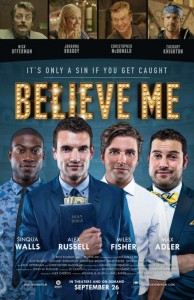
Believe Me - Movie Review by Eric Forthun

believe meBelieve Me  

Starring Alex Russell, Zachary Knighton, Johanna Brady, Max Adler, and Christopher McDonald

Directed by Will Bakke


Rated PG-13

Run Time: 93 minutes

Genre: Comedy/Drama


Opens September 26th


By Eric Forthun of Cinematic Shadows


Films that aim to tackle religion comedically and from multiple viewpoints often lose themselves on their journey. Believe Me, unfortunately, falls into that trap of being aggressively against religion while simultaneously crafting kind, likable characters within religion. That makes for an uncomfortable dichotomy that grows from the central characters conning religious believers for personal gain. While atheists may revel in the susceptibility of religious characters to believe anything, the film presents the college seniors at the heart of the film as arrogant, self-involved pricks. Not exactly the best dynamic. The film focuses on Sam (Alex Russell), a student that loses his scholarship for the semester after realizing that he has yet to pay for summer classes, leading to financial ruin. He can think of no alternatives or solutions, considering dropping out of school rather than find a way to make money.


And then it clicks. He sees the success that churches have with raising money for mission trips and good causes, discovering that in a conversation with a church-going girl that details how it's difficult to track money when accrued like that. He figures they can do one fundraiser for helping kids in Africa (as if that already wasn't a clichéd, privileged concept) and pocket almost all of the money. But afterwards, they are approached by members of one of the biggest religious groups in the United States to go on tour across the country. Most of Sam's friends are reluctant, with Pierce (Miles Fisher) standing opposed only until he finds out that money is involved. Tyler (Sinqua Walls) thinks it's immoral but doesn't want to lose his friends, while Baker (Max Adler) plays along because he's there for the ride. Sam's also driven by his lust for one of the organization's leaders, Callie (Johanna Braddy), who unfortunately is tied to Gabriel (Zachary Knighton), a musician that leads the church's band.


The film is sprinkled with comedic supporting actors, with Nick Offerman shining terrifically as Sam's financial/academic advisor. His solemn advice on life is hilariously delivered and oddly misplaced in a film that doesn't carry the same style of humor. Christopher McDonald plays the organization's leader that wants them to be the best they can; he's an honorable, decent man that never fits the stereotype of a comedic fool within religion. It's a relief considering much of the film acts as a group therapy session for bashing religion and the gullibility of its members. I'm not a religious man myself, and I didn't disagree with many of the things that the main characters preach about religion. But when the faith within the film itself isn't mean-spirited and isn't harming anyone, then why is it something to mock? It undermines the film's focal argument by insisting that these characters are committing corrupt actions but that they are justified due to the fallibility of religion.


Believe Me doesn't say all that much about religion itself. There's a surprisingly intimate scene late in the film between Sam and Callie, discussing the nature of his business and just how malevolent and awful he is. It's rare these days to see films address their antiheroes with such candor, yet in doing so reminds us of just how unlikable the protagonists are. There's nothing particularly charming about their actions because most of the film involves them wallowing in the money they've stolen from good individuals. Religious characters are treated as the level-minded, guilt-free individuals, another compelling characterization due to the way that cinema traditionally lambasts religion. Yet the narrative never works with Believe Me's message, particularly when the story gets familiarly messy and has every character discover everything about everyone. There's a certain intrigue behind the film's portrayal of religion, but the story falls flat and uses malice as its lead voice.

The Maze Runner - Movie Review by Monte Yazzie

maze runnerThe Maze Runner  

Dir: Wes Ball

Starring: Dylan O’Brien, Ami Ameen, Ki Hong Lee, Blake Cooper, Thomas Brodie-Sangster, Will Poulter, and Kaya Scodelario


Rated PG-13

113 Minutes


By Monte Yazzie of The Coda Films


“Never go beyond the walls”. A rule inherently made to be broken by the young men confined behind massive, mechanical walls in director Wes Ball’s adaptation of James Dashner’s young adult novel “The Maze Runner”. A plethora of films featuring youth in peril in a dystopian future, most based off beloved novels, have saturated the cinema recently. Most of these films are featuring the usual derivative storytelling accompanied by decent enough acting, unfortunately because these kinds of stories are becoming so common nothing feels surprising. “The Maze Runner” falls into some of these pitfalls, however with great performances from supporting roles and a plot that unabashedly keeps the viewer in the dark until the end; the film sustains a sensation of intrigue amidst the confusion.


Waking up in an elevator with a group of young men standing intimidatingly over top of him, Thomas (Dylan O’Brien) is imprisoned in a constructed maze. Inside the maze is a community of young men primitively surviving, each of them arriving in the same mysterious way as Thomas. They have organized their own society with rules and responsibilities that each person abides to, and everyday a specific group of members known as “runners” navigate the maze in hopes of finding a way out. Though every night the maze closes and monstrous animals called Grievers arrive to ward off exploration. Thomas’ impulsive actions throws discourse into the population, but the sudden arrival of a young woman who recognizes Thomas changes everything.


Imbued with tones similar to “The Lord of the Flies”, the narrative provides some interesting surface level examinations on brotherhood, maturity, and group mentality influenced by fear and survival. While this in-depth character and narrative development doesn’t continue long enough to get into the more thought-provoking material involving the motivations of these young men, it does offer an attention grabbing introduction. Unfortunately the suspense of the claustrophobic atmosphere is lost once the film transitions into the rolling mystery, which regrettably goes nowhere and instead fills the plot with more damaging questions than satisfying answers. For those that have read the book, the film may have a slightly different appeal, but for those coming in cold, the film feels like a prolonged sequel setup.


Still, the performances from the cast are quite good. In the lead Dylan O’Brien is effective though somewhat overshadowed by the supporting cast. Two in particular offer great contrasts for the group. Ami Ameen plays community leader Alby with concern and control, the figure of positive leadership for the young men. While Will Poulter playing villain hides the inner fear he is feeling with an outward menace that lashes out whenever he gets scared. This comes to characterize his ambitions as his fear gains full control of his emotions. Unfortunately some improbable motivations from the characters and strained dialog moments interrupt the performances, allowing the flaws within the narrative to show through.


Amidst good performances and some skilled techniques that attempt to add depth to the narrative and build tension within certain scenes, “The Maze Runner” eventually leaves the audience in a place of confusion where only a sequel could remedy the messy plot and satisfy the many pending questions being asked in the end.


Monte’s Rating

3.00 out of 5.00


This Is Where I Leave You - Movie Review by Eric Forthun

Where I Leave YouThis is Where I Leave You  

Starring Jason Bateman, Tina Fey, Jane Fonda, Adam Driver, Rose Byrne, and Corey Stoll

Directed by Shawn Levy


Rated R

Run Time: 103 minutes

Genre: Comedy/Drama


Opens September 19th


By Eric Forthun of Cinematic Shadows


This is Where I Leave You stands amongst those films that have a tremendous ensemble cast but never strive for anything more than safe storytelling choices and contrivances. The film comes from Shawn Levy, a traditionally studio-oriented filmmaker that doesn't have a distinct style so much as a distinct knack for making money through highly commercial films (i.e., the Night at the Museum franchise, Date Night, Real Steel). This latest effort gets a release after premiering at the Toronto Film Festival, which is a fitting choice considering the crowd-pleasing nature of the narrative. The story is sweeping and often operatic when it involves characters facing the plight of dealing with their father's death, yet the film's comedy is the thorn in its side. The humor derives not from characters or even well-defined situations, but rather snappy one-liners that feel as insincere and clichéd as if they were copied and pasted from other better comedies.

The film centers on the aftermath of a family coming together for their father's funeral, primarily looking at four grown siblings: Judd Altman (Jason Bateman), a radio show producer that finds out his wife, Quinn (Abigail Spencer), is cheating on him with his boss, Wade (Dax Shepard); Wendy (Tina Fey), who has multiple children with a husband that's absent and misses her former love, Horry (Timothy Olyphant); Phillip (Adam Driver), the oddball that comes to the funeral engaged to his therapist, Tracy (Connie Britton); and Paul (Corey Stoll), the level-headed one of the bunch that's married to Alice (Kathryn Hahn), an old flame of Judd's. Their mother, Hillary (Jane Fonda), gathers them together to practice Shiva, a Jewish tradition of staying together for seven days after a family member's death. This brings all of the chaos into one household and makes for an eventful week.


Each storyline gets about ten minutes of development. While that could be effective if there were subtlety within the film, This is Where I Leave You allows itself to paint broad pictures of potentially complex characters. There is depth within each of these creations, particularly Judd. Bateman provides a terrifically nuanced performance due to the hard-nosed drama coming from his life, particularly when he gets back to town and interacts with a homegrown girl played by Rose Byrne. The first scene of the film showcases Bateman's acting talents and the possibility of the film being moving: he discovers his wife cheating on him and the camera juxtaposes his image with a mirror of himself sitting in the dark. Then he blows out the candles on his wife's birthday cake and walks out the door, signifying him blowing out the flame of his love and moving forward. It's a strikingly beautiful scene, but every scene after is filled with on-the-nose emotional cues and dialogue that never meshes with the strength of certain characters.


The supporting performances are strong yet most remain insubstantial in terms of their arcs. Byrne is delegated to nothing more than an object for Judd to discover himself while characters like Alice and Horry get one defining characteristic and drive it home. It's frustrating considering the talent put on display here, with most of the actors attempting to elevate the material past its admittedly flimsy foundation. Jokes revolve around Fonda's character's boob job and most of the supposed laughs come from big proclamations coming at inopportune times during family gatherings. Not once did the comedic material strike me as sincere or grounded in any semblance of reality. The lines sound like they are being delivered by robots exchanging one-liners with one another. I love the cast in the film, and the strengths come from the dramatic elements of the stories. I engaged heavily with those. Yet much of the feature relies on trite, off-putting humor, leading to a middling, confused film.

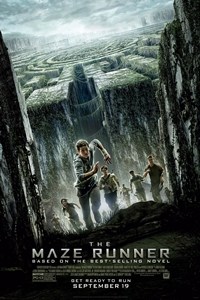
The Maze Runner - Movie Review by Eric Forthun

maze runnerThe Maze Runner  

Starring Dylan O'Brien, Kaya Scodelario, Will Poulter, Aml Ameen, and Patricia Clarkson

Directed by Wes Ball


Rated PG-13

Run Time: 113 minutes

Genre: Action/Sci-Fi


Opens September 19th


By Eric Forthun of Cinematic Shadows


How can newly released young-adult dystopias set themselves apart from the rest of the pack? The Maze Runner doesn't do anything particularly exciting or innovative past its admittedly promising concept, but the male-driven narrative will undoubtedly draw in a wider audience than many of the recent adaptations of popular teenage novels. The film picks up in an immediately claustrophobic and stressful moment: Thomas (Dylan O'Brien) wakes up in a steel-caged elevator that's climbing at a rapid pace. He doesn't remember anything about himself and is surrounded by various barrels and crates, labelled with the letters "WCKD." When the doors open above him, the sun is shining, faces greet him, and he runs for his life when given the chance. Only then does he notice that there is no escape: surrounding him and the other inhabitants are impossibly high walls that form a maze around them. The maze changes, the gates only open for a limited time, and many boys have been trapped or killed within its walls.

Thomas has a curiosity that the others do not share. Alby (Aml Ameen), the group's leader, tries to test his ability as a "runner," a term used for the people that attempt to map out the maze while the gates are open. Thomas wants to find the quickest way to escape and doesn't understand how everyone could be okay with not remembering anything about their past. One of these boys accepting of their circumstances is Gally (Will Poulter), someone who doesn't take kindly to Thomas's unwanted exploring and the mistrust and displeasure he brings the group. This leads to more people being attacked by the nightmarish Grievers, unseen creatures that inhabit the maze, while a mysterious girl (Kaya Scodelario) arrives in the monthly elevator delivery with a strange note that changes the game altogether. Why have all of these boys been trapped in the affectionately titled "The Glade," and is there any chance at escape?


That question is a fascinating one, primarily because the film builds tension through the mystery of its visuals. The maze is enthralling and portrayed terrifyingly. There's a telling scene as a character gets stung by a Griever, returning to camp but posing a threat to everyone there. As a society, they decide that the person must be banished; the only way that can happen, then, is by forcing him into the maze as the gates close. No one has ever survived a night, and that won't happen here. It's a harrowing exploration of adolescents as they handle adult situations, even if the story starts to grow repetitive. What grows particularly frustrating as well is the growth of clichés as the story develops further. The final half hour is chock full of every predictable element of young adult novels, whether that be a young character as a martyr of innocence or an enigmatic leader that might be good but also could totally be evil. It's just too simple and formulaic.


The conclusion lost me. It's incredibly difficult to translate dense novels to film, especially when they are surrounded by mystery that might need characterizations to pop but cannot be delivered through dialogue. There are probably two or three films worth of material that are revealed in the increasingly drawn out conclusion, as the characters find out the answer behind the maze, amongst many other things. The characters are thin due to their lack of knowledge about themselves so the actors do not have much to work with; that lends itself to bland, interchangeable performances, outside of O'Brien in the lead. He's a strong presence that provides a young anchor for the film. There are structural problems, certainly, most of which go unnoticed since the film begs questions throughout. Yet the lack of conclusion surrounding many central problems leaves the story too open for a sequel. The Maze Runner is a promising, ambitious film, but it's also frustrating and incomprehensibly dense.

The Disappearance of Eleanor Rigby - Movie Review by Eric Forthun

Eleanor RigbyThe Disappearance of Eleanor Rigby  

Starring James McAvoy, Jessica Chastain, Viola Davis, Bill Hader, Isabelle Huppert, and William Hurt

Directed by Ned Benson


Rated R

Run Time: 122 minutes

Genre: Drama


Opens September 19th


By Eric Forthun of Cinematic Shadows


The Disappearance of Eleanor Rigby started as two separate films with the subtitles "Him" and "Her." Each film stood as their own narratives with both lovers separated after their marriage begins to fall apart. The director and writer, Ned Benson, realized that the two would need to be combined in order to make a marketable, releasable feature, thus creating "Them," the theatrical version of the romance. Condensing a four-hour romantic tale into two hours must have been extraordinary difficult given the circumstances of the narrative, with both actors spending a lot of time apart and only sharing select scenes with one another. Yet the result is a remarkably affecting tale of love lost under the most dire circumstances, and the struggles that come with a long-term romance disrupted by tragedy. While the film at times falls into conventional trappings and broad strokes, the romance works tremendously when built by the drama of the two terrific leads.


Conor Ludlow (James McAvoy) and Eleanor Rigby (Jessica Chastain) once had a blissful marriage, surrounded by a strong group of friends and family. Yet their life together fell apart at the loss of their child, forcing them to reconsider how their marriage can survive when the passion seems to be lost. Eleanor leaves Conor and attempts to kill herself, not succeeding and moving in with her parents, Mary (Isabelle Huppert) and Julian (William Hurt). Her mom is from France and likes to drink wine while her father works at a university and wants Eleanor to get back to school. Maybe that'll set her life back on track and help her find happiness. She enrolls in a class taught by Professor Friedman (Viola Davis), who has an older son and connects with Eleanor's passion. Conor runs a struggling bar and works with his best friend, Stuart (Bill Hader), a chef that wants to help Conor become less...unfriendly. Eleanor and Conor, in their separation, have grown apart from the other people that they love.


There's a delicacy to the film's portrayal of love and loss. In the film's opening moments, a long take looks at the back-and-forth banter between the two lovers when they were happy. The camera quietly observes, silently letting their actions and words speak for their characters. Moments later, both characters are seen separated and battered by self-inflicted injuries. They are literally hurt by being apart. The film shines when it puts ideas on screen in that low-key way, particularly due to the exemplary cast on hand. The supporting players like Hurt and Davis are given plenty to chew, with the latter in particular using complaints about her son to emphasize the loneliness Eleanor feels at the loss of her only child. There's a harsh scene where Friedman complains about kids and how they won't care about you after they leave home, and she asks Eleanor if she has any children. She responds yes, if only to hide the fact that she misses her son and that Friedman has no excuse to complain about a living child.


The heart of the film is Chastain, who breathes tremendous life into her role and has the more dramatically ripe story. Her and McAvoy mirror one another often throughout the film due to their characters going through similar struggles, but Eleanor deals more sensitively with her issues while Conor externalizes most of his. The tragedy underlying the story only rarely emerges; a scene in particular where Conor talks with his restauranteur father (Ciarán Hinds) about their pasts and where their love and happiness went is mesmerizing and tragic. When the film generalizes love, which occasionally emerges in father-daughter conversations, the story aims too broad and misses its mark. But the performances shine through in the film's final half hour, with two gut-wrenchingly beautiful and haunting scenes delivered back-to-back. Benson's film is propelled by Chastain's magnetic, overwhelmingly effective performance, one of the year's best. Despite its occasional mishaps, The Disappearance of Eleanor Rigby is a gorgeously intimate study of a struggling romance.

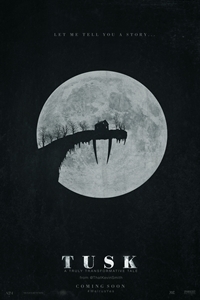
Tusk - Movie Review by Eric Forthun

TuskTusk  

Starring Justin Long, Michael Parks, Haley Joel Osment, Genesis Rodriguez, and Guy Lapointe

Directed by Kevin Smith


Rated R

Run Time: 102 minutes

Genre: Horror


Opens September 19th


By Eric Forthun of Cinematic Shadows


Kevin Smith is one of the most divisive filmmakers in the business, a writer-director that stands by his work and doesn't let others get in the way. I'm a fan of some of his films but not all: I really enjoy Dogma and Zack and Miri Make a Porno, I cannot stand Cop Out or Red State, and his other efforts don't particularly connect with me. His films are the strongest when he deals with familiar themes and genres and tackles them with ferocity and scorn. Tusk, his new horror feature, is brilliantly demented and biting, showing a reinvigoration that the filmmaker hasn't seen in years. He takes a well-worn atmosphere and re-creates a truly unsettling premise, uniquely combining elements from horror classics like Misery and repulsive recent efforts like The Human Centipede. The film descends into madness after its set-up and becomes a perverted vision of humanism, one that will remain unforgettable.


The story follows Wallace Bryton (Justin Long), an immature podcaster that resorts to mean jokes for cheap laughs and cheats on his girlfriend. He works with his long-time friend, Teddy (Haley Joel Osment), on their show called the Not-See Party, with the title screaming a tasteful affair. They seek out an interview with a YouTube sensation that embarrassed himself, so Wallace travels to Canada in search of this man for a prized interview to mock him to death. Unfortunately for them, the kid is unavailable to interview, leaving Wallace lost and unfulfilled. Only then does he discover an ad in the bathroom that leads him to the home of Howard Howe (Michael Parks). Howard is an old, feeble man that accommodates Wallace and tells him memories from his past. He has extravagant stories that detail the brutality of man, his incredibly dark and tragic backstory, and his affinity for God's greatest creation: the walrus.


Things end up turning sour when Wallace is drugged and forcibly put into one of Howard's experiments. He's not as feeble and simple as he seemed. Teddy and Wallace's girlfriend, Ally (Genesis Rodriguez), search for him and uncover darker secrets about Howard while Wallace realizes the endgame of his transformation. Smith's vision for the film is one of his most confident. The camera moves lyrically and waxes across a scene to build maximum tension; long takes appear often and heighten the unsettling nature of many of the settings. The camera often lingers on Howard's face as he tells lavishly detailed stories about his war-torn past and why he loves walruses and hates men as much as he does. There's a certain way that Smith approaches these stories that speaks truth about storytelling: the magnetic power it can have over the listener and the way that it can contort a person's perception of reality. Howard is undeniably crazy and Parks sells the performance with his usually insane charisma.


The writing, like many of Smith's films, uses the first half to set up the far-fetched premise by grounding the story in reality and characters. The second half becomes unchained and chaotic in every facet, yet the story remains shockingly sound. The introduction of Guy Lapointe (played by an actor named "Guy Lapointe," an unrecognizable superstar in cameo form) has the story drift into Tarantino-esque eccentricity and violence, but the narrative remains compelling. The performances all-around are committed, particularly from Long as he makes a horrible person into an oddly sympathetic embodiment of humanity. The ending packs a punch due to his portrayal of Wallace. Smith hates podcasters and likes the idea of Canadians, and his bite cuts through scenes to ensure the audience understands that. Tusk is one of the more singular visions I have seen in 2014, a film that satisfies horror fans while managing to deliver a solemn, effective conclusion.

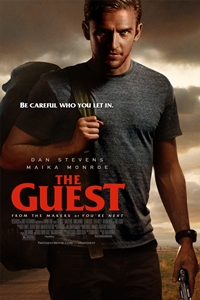
Interview with the team behind The Guest by Michael Clawson

Guest by Michael Clawson of Terminal Volume


The Guest chugs along like you know what’s going to happen. It knows you know. And it’s still one step ahead of you.


The film — directed by the You’re Next up-and-coming duo of director Adam Wingard and writer Simon Barrett — starts as a thriller so basic that it could be shrink-wrapped and sold at a Walmart in the clearance section. An Afghanistan combat veteran shows up at the house of a dead Marine buddy, whose family welcomes him in and lets him stay over, borrow the car and prepare dinner with their sharpened cutlery. But the veteran, David (played with a psychotic gaze by Downton Abbey nobleman Dan Stevens), is not who, or what, he says he is. And then people start dying.


“There’s a couple of abrupt tonal shifts …” screenwriter Barrett said during a recent stop through the Valley to promote the film. “One thing we were really trying to play with a lot was the idea of experimenting with character likability, and obviously I’m primarily referring to Dan Stevens’ character — you just love him and he’s so entertaining. We treat him seriously as a character, and his behavior and his reactions are consistent, and at a certain point, that becomes a darker thing.”


Stevens’ David, whose thousand-yard-stare requires a gun permit in a handful of states, slowly unr

avels, though the film has a sinister sense of humor that collects his unspooling psyche into bundles of dark comedy. The film ends in a Halloween maze with David as the haunted attraction’s resident ghoul, the monster that stalks the guests. Before that, though, David mops the floor with some brazen cosmo-drinking high school kids, he blackmails the school principal, and obliterates the male competition at a house party when his muscle come in lugging the remaining kegs. David is a murderous madman, but he has his charm, an aspect of the movie that is twistedly delightful, but one that audiences might have a hard time swallowing.


“We did a similar thing with You’re Next, where the movie got increasingly comedic as it went along, and climaxed with this kind of absurdist monologue,” director Wingard said. “You’re Next was a gradual progression. The Guest was much more of a 90-degree turn … As a viewer, that’s the kind of stuff I enjoy and find fun: when a movie pulls the rug out from under you, as long as it’s grounded in a reality with characters that make sense.”


I would argue that the David character makes little to no sense. He spends much of the movie helping people to only kill them in the last act. His motives are frail and without much justification. And the terrifying thriller he’s crafting is yanked from him in a military twist that deflates the The Guest’s more robust possibilities. But David somehow still works, if only because Stevens’ is so kinetically malevolent that he outshines the material. (Stevens was on the press tour, but sidelined by an illness and unable to speak with the press.)


“[Stevens] just kind of personified what you really want out of a mysterious character like this,” Wingard said. “He has to earn the characters’ trust to integrate himself into the family’s lives. So we wanted an actor that the audience already trusted to begin with. Their association with him is the polite, mild-mannered Matthew Crawley [from Downton Abbey], and so that association is what we’re kind of playing with.”


Wingard continues: “… Ultimately what we’re playing with is creating a character that we want to conflict the audience. We want to throw the notion of a hero or a villain out the door, and all you should be focusing on is ‘are you being entertained by this guy?’ Dan had all those aspects to him. He’s a very intelligent guy, he got the sense of humor of the script, and we already knew he could act.”


It was their first time working with Stevens, although Barrett and Wingard are frequent collaborators. Frequent enough that I ask them if they’re sick of each other yet.


“I would say the key to our creative process is that we actually know when to give each other a lot of space,” Barret said. “Like when Adam is editing, I stay completely out of the editing room, so that I can then bring objectivity to his first cut. Adam’s first cuts tend to be more polished than a lot of people’s final cuts … But that’s about two months that I just stay out of his way while he works, and generally I’ll take advantage of that time by writing. That’s one of the good things about our partnership — we’re doubly productive. When I’m writing a script, I tend to not show Adam any pages until I have a final draft, and I try to surprise him with the story and characters.”


Wingard agrees that the they function well together and apart: “We tend to not really just hang out on a casual basis that much, even though for awhile we lived literally next door to each other. When you’re shooting a movie, you’re around each other every day, and then you go on these press tours … so it’s not like we’re starving to hang out.”


To see these two hang out behind the camera, check out The Guest, which opened Wednesday.

The Guest - Movie Review by Eric Forthun

GuestThe Guest  

Starring Dan Stevens, Maika Monroe, Brendan Meyer, Sheila Kelley, and Lance Reddick

Directed by Adam Wingard


Rated R

Run Time: 99 minutes

Genre: Thriller


Opens September 17th


By Eric Forthun of Cinematic Shadows


The Guest is insanely inventive and gleefully manic, a madly energetic psychological thriller with pizazz and spunk. The film is built on a simple premise: a man arrives as a guest in someone's home but doesn't seem to be who he says he is. The story turns out to be much more grandiose and funny than that set-up insinuates, however, allowing the characters to appropriately embrace the absurdity and humor that would derive from such a tense, hostile situation. The titular visitor is David (Dan Stevens), a recently discharged soldier returning from Iraw to his hometown. He doesn't have a place to stay so he hopes that going to the Peterson family's house won't be too much trouble. Their son passed away during the war months ago, and David served with him. Maybe he'll be able to bridge that mourning period for the family and help them through their suffering.

The Peterson family has an interesting group of members that all take kindly to David: the mother (Sheila Kelley) likes David because he's telling her all about her son and she can live through his experiences; the father (Leland Orser) is struggling to move up in his workplace and likes to have a buddy with whom he can drink and talk sports; the daughter, Anna (Maika Monroe), begins to crush on him after he joins her for a party and seems to be the coolest cat in the room; and the son, Luke (Brendan Meyer), likes him because David kicks the asses of his bullies and gives him sound advice for future situations. The problem with all of them growing high on David? He's not who he seems to be. That's the central struggle at the heart of the film, with something clearly wrong with David through his lies and vicious anger issues. When the military gets involved and a unit led by Carver (Lance Reddick) begins to enter their town to investigate, things escalate quickly.


Director Adam Wingard and writer Simon Barrett have now paired for two excellently subversive romps on well-worn genres. Their previous effort, You're Next, is a hilarious and viciously told horror entry, proving that the genre can indeed be sparked with new life when taken differently down a familiar path. The Guest plays on many of the same strings: the story is straight out of '80s B-movie heaven, with the mysterious man with a particular set of skills creating a hostile force in a family unit. But David is seemingly superhuman for much of the film, able to withstand excessive amounts of alcohol, drugs, and violence with pretty rapid recovery. It's funny to see how calmly he handles situations since it resembles a charming, handsome robot destroying everything in his path. Dan Stevens sells the role perfectly and commits wholly, giving David a likable edge that goes crazy in the final half hour.


The story grows too nonsensical during its conclusion, tying together loose ends with seemingly bigger questions. Yet it remains engaging because of the performances and the self-aware nature of its narrative. One of the best scenes in the film involves an ode to a scene earlier, when the patriarch of the Peterson family complains that his boss is going to give a higher-up position to someone else when he deserves it more. Later, he comes home with a somber face and tells the family that his boss apparently committed suicide. It's all somber until he tacks on at the end that the bright side is that he's going to get promoted. The film plays these horrible actions for laughs because a self-conscious story needs a bit of humor to feel original. The Guest is sporadically comparable to efforts like The Stepfather and Jacob's Ladder, two serious films from vastly different genres that get at the idea of an unwelcome invader and military experiments, respectively. Yet instead of paying homage, the story sticks up a big middle finger to those stories and tells its own twisted narrative.