
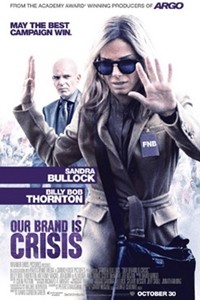
 The political film ‘Our Brand Is Crisis’ inexplicably mixes messages
Director: David Gordon Green
Starring: Sandra Bullock, Billy Bob Thornton, Anthony Mackie, Joaquim de Almeida, Ann Dowd
“Politics have no relation to morals.” – Niccolo Machiavelli
I suppose if one polled the American people, a vast majority – these days - would probably agree with Machiavelli’s statement. If this perception on politics is, in fact, reality, then imagine the corrupt, behind-the-scenes street fight it takes to actually get elected into office. Dirty tricks, coercion, guerrilla marketing, and lies might only be the tip of this crooked iceberg. Political campaigns are about one thing, winning. In “Our Brand Is Crisis”, a Bolivian presidential candidate (Joaquim de Almeida) is behind by 28 points, so, in other words, he is in dire need of immediate help.
His team reaches out to a long-time political strategist (Sandra Bullock), and this former wonderkid is in seclusion after losing some tough races. Jane (Bullock) lives in an isolated cabin under peaceful but snowy conditions. She gets crafty by making ceramic bowls and gets healthy by avoiding cigarettes and alcohol. Although Jane is not necessarily happy, she is calm, and for right now, serenity is more important than contentment. Soon, however, Nell (Ann Dowd) and Ben (Anthony Mackie) convince her to get back into the game, pull some rabbits out of her hat and get their struggling candidate, Castillo (de Almeida), elected president.
Director David Gordon Green’s (“Pineapple Express”, “Snow Angels”) movie sets up like a biting, sarcastic and dark comedy.
Jane tries to wake up her campaign-muscles in a foreign land against a very familiar opponent, her old nemesis Pat Candy (Billy Bob Thornton). Candy, of course, is the key strategist backing the leading presidential candidate, Rivera (Louis Arcella). This enticing canvas of soiled gamesmanship - between two formidable foes under an unfamiliar backdrop - has some key elements of intriguing cinema.
Bullock really shines here. For instance, Jane runs into major physical issues due to Bolivia’s high altitude, and Bullock plays into these under-the-weather elements to great comedic effect. She is supposed to be a brilliant strategist, but Jane is checked out due to her lack of excitement over Castillo’s chances and her sudden illness, and Green captures some hilarious sequences. Despite Castillo’s political stature, Jane is the most important person in the room, and the camera loves her. As an audience, we cannot take our eyes off of Jane due to the previously-mentioned humor and her wildly sharp intellect. She rattles off quotes from Muhammad Ali or Warren Beatty like an active Gatling gun sitting on a hilltop, and we hang on every word.
Unfortunately, the film falls off the rails in a few areas, and one of them ironically is due to the main focus on Jane. Jane’s main antagonists are Candy, Rivera and Castillo. Green rightfully focuses his time on Jane’s mind games which grind up the Candy/Rivera team and ensure Castillo plays ball with her decisions. On the other hand, the film never gives much (or any) insight into what Candy, Rivera and Castillo are thinking. Any worthwhile movie hero deserves an equally formidable “villain”, and the film only presents Jane’s side to the political back and forth. Candy and Rivera deliver their shots and Castillo presents resistance, but the screenplay does not reveal their internal strategies, conversations or thoughts. We usually (if not always) see the shots fired and received from Jane’s perspective, and this effect makes the film much less interesting.
The movie does hold an effective, uncivil discourse between Candy and Jane, and it tracks Castillo’s logical rise and Rivera’s fall in the polls. Come the final debate and Election Day, the sparks should fly. Inexplicably, this movie’s targeted crescendo is delivered with the enthusiasm of a paper boy on autopilot during a random weekday route.
“Our Brand Is Crisis” builds up sizable dramatic tension, but then shrugs its shoulders during the moment of “truth”. It is a real letdown. Even worse, rather than carrying through its effectual sarcastic tone, the movie turns sanctimonious. The film’s dichotomous tones do not fit nor work, as the original, cynical feel bewilderingly becomes self-righteous.
Regrettably, I was left wondering what this movie really wanted to be. Well, at least the film does not make an immoral mistake. Just a baffling one. (2/4 stars)
 Room
Room
 Rock the Kasbah
 ‘Bone Tomahawk’ tosses an exceptional, gritty and gory western onto big and small screens
 “’The Last Witch Hunter’ adds good ingredients but undercooks the brew”
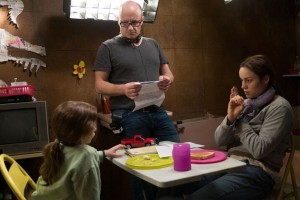 Interview - Lenny Abrahamson, the director of “Room” (2015)

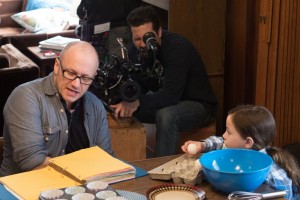 PFF: One of the pleasures of the film is Jack’s narration, as he explains the way he sees the world. What lessons can adults take by looking at life through a kid’s eyes?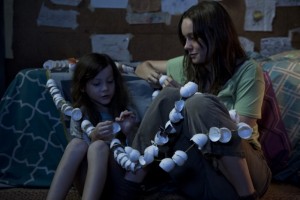
 “A well-designed ‘Steve Jobs’ leaves the audience wanting a future release”
 Bridge of Spies
 “The foreclosure film ‘99 Homes’ serves stressful theatre”
 “He Named Me Malala” features an extraordinary woman in a less-than-perfect documentary
 The Final Girls
 Interview – Adriana Trigiani, Jenna Elfman and Paul Wilson of “Big Stone Gap”


 “Mendelsohn and Reynolds are a pair of aces in ‘Mississippi Grind’”
 The Walk
 The Martian
 Sicario
 The Intern
 A Brilliant Young Mind
 Interview – Oren Moverman, director “Time Out of Mind”
By Jeff Mitchell
Interview – Oren Moverman, director “Time Out of Mind”
By Jeff Mitchell people. New York is quite an overwhelming city in terms of the mass volume of humanity in your face all the time. The more people there are, the more alone you can be. When you have so many people (in one place), then they (simply) do not see each other. So, I think the state of homelessness - that kind of isolation - leads to deprivation of very basic needs. The lack of eye contact or human contact just makes the problem worse for sure.
  OM: That was our biggest worry: Are we going to get away with putting Richard Gere in this environment. We tested it. What we discovered – when we hid the camera, because we didn’t want the camera in people’s faces to give away the fact that we’re shooting a movie - is they didn’t recognize him at all because they didn’t look at him. It was a very deliberate, very understandable, very human, and a very New York approach. Urban dwellers would just walk past this homeless guy, and maybe someone would pay attention and maybe someone would give something, but ultimately no one looked him in the eye. It wasn’t as if he was unrecognizable as Richard Gere. He was unrecognizable as a movie star, for sure. He was unrecognizable in his clothes because that’s not how you would expect to see Richard Gere. The fact that no one looked him in the eye, it was a lesson for us when someone in that position becomes quite invisible to the people around him. He did get recognized twice in Grand Central Terminal when two people walked by him and said, “Hello”. It wasn’t sort of “Oh my God, it’s a movie star. Let me take a picture.” It was more like, “Hey, he looks like Richard Gere. It looks like he is having a hard time.”