It is a rare and exceptional feat when a filmmaker manages to seamlessly layer a terrifying supernatural horror tale with a tender, coming-of-age queer love story. Yet, that is exactly what director Adrian Chiarella accomplishes in his striking feature debut, Leviticus.
While this marks Chiarella's first time at the helm of a feature film, he displays a confident understanding of the horror genre and an impressive talent for character building. He deeply understands the traditional mechanics of genre cinema, and, more importantly, exactly how to subvert them. Rather than relying on cheap scares, Chiarella uses the horror framework to meticulously build a deeply resonant story of identity and resistance in the face of systemic oppression.
This thematic depth is supported by the exceptional, emotionally raw performances of its two leads, Joe Bird and Stacy Clausen. Their undeniable on-screen chemistry provides the beating heart of a film, often equal parts heart-wrenching and spine-chilling.
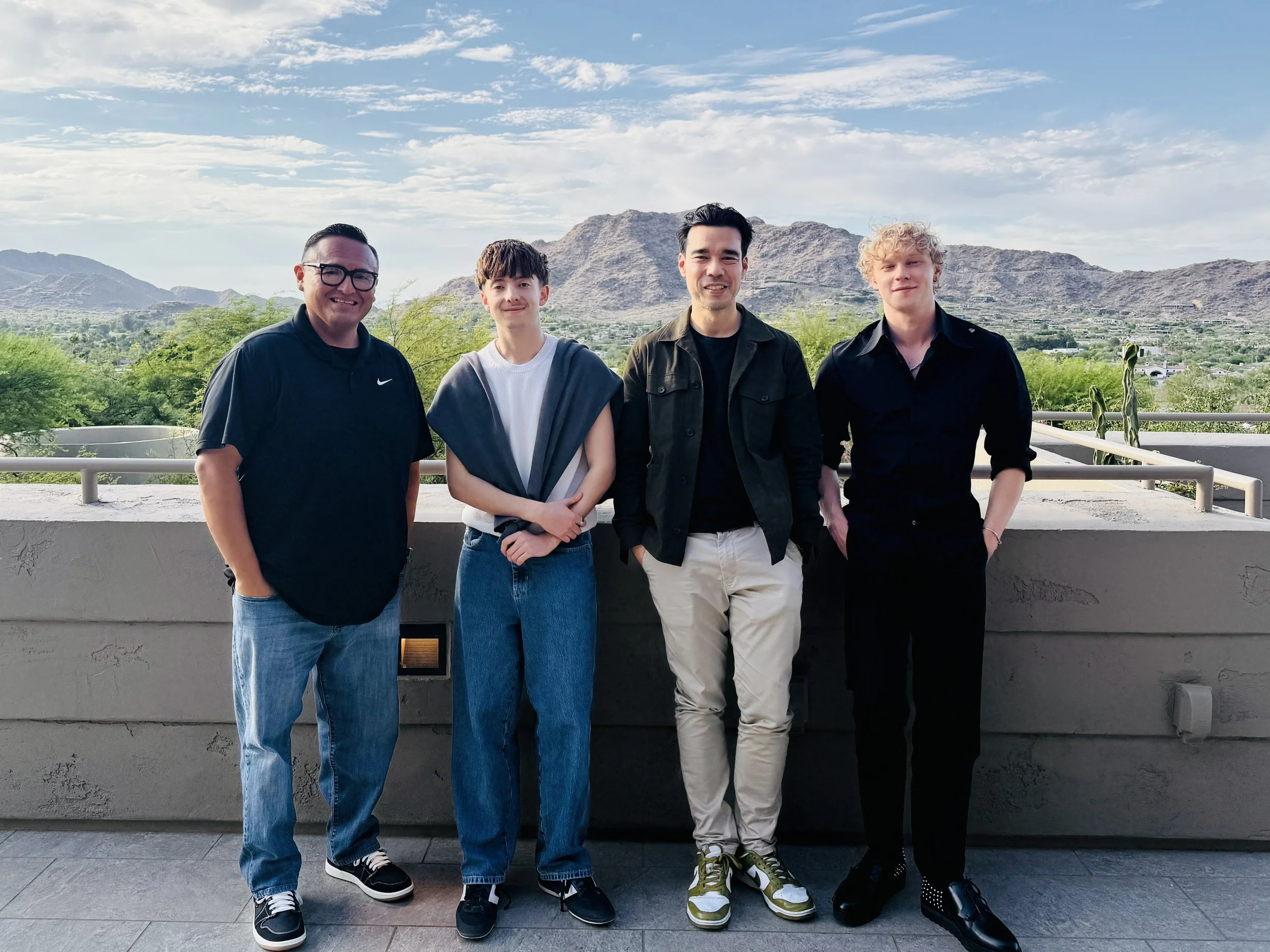
The Phoenix Film Festival had the absolute pleasure of sitting down with director Adrian Chiarella and stars Joe Bird and Stacy Clausen to discuss subverting horror tropes, building intimacy amidst terror, and taking a special look at each of their "handshake five" cinema choices.
Balancing Horror and Romance
Interviewer: You manage a great balancing act here between horror and romance, showing how what we fear and what we love can be interchangeable. Horror fans sometimes get asked, How do you find so much comfort in horror? And then those same people, the horror fans who can go to sleep with a violent, scary horror film as background noise, can't go up and talk to somebody that they care about because that's the scariest thing that could happen to them. How did you, Adrian, approach tackling that specific dichotomy between fear and romance when you began this process?
Adrian Chiarella: Uh, for me, it was something that I knew had to be calibrated really carefully. Like, I knew I wanted to do that, exactly what you were talking about. And I knew there would be a lot of—it's especially hard when you're writing a script because of sort of all the pitfalls people don't want you to fall into; they're going to steer you away from. And so, I knew that I was going to have to really work hard to convince people that this was going to work. And it was just a lot of writing, rewriting, and exploring.
I think for me, once I came up with the mechanism of the horror element—once I had this horror movie monster—then I could sort of park that and focus on the love story in the writing. And then it was just a matter of, like, bouncing between the two as I went through and worked on the script. And in fact, that balance was something that we worked on all the way through to the end of the edit, the end of the sound mix, really. We were constantly taking scenes out, putting them back, and figuring out, like, "Oh, hang on, we've got a horror movie that hasn't had any scares for 45 minutes, what are we doing?" So then we'd go back and look at the film's structure.
On-Screen Chemistry and Preparation
Interviewer: The authenticity between you two, Joe and Stacy, is amazing. Did you know each other or work together before production, or was this your first time meeting?
Stacy Clausen: Well, when we showed up to set, yes, we were friends by that point.
Joe Bird: Yeah, but like, we didn't really know each other, right? I mean, we'd text on Instagram and be like, "Hey, like, we're doing this film together." But no, we didn't actually have a proper chance to hang out until pre-production started. But we did FaceTime a few times beforehand, which was nice, and we just got to know each other.
Adrian Chiarella: I always bring up that you play Fortnite; I love that detail.
Joe Bird: Yeah, we play Fortnite. That's awesome. We play games together.
Adrian Chiarella: Fortnite is an actor's technique, an actor's tool. Play Fortnite with your scene partner.
The Editing Process
Interviewer: The film is so meticulously paced, and it really takes its time establishing the world. Knowing your background in editing, did you find yourself shaping that deliberate rhythm on set, or was it primarily found in the editing room
Adrian Chiarella: I worked with Nick Fenton, who is an incredible editor. He's worked with great directors on Björk's music, in some of her videos, and at her concerts, but he's also worked with incredible directors like Anton Corbijn, Justin Kurzel, and many others. He happens to live in Victoria, Australia, because his family is there, and he was looking for a project, and I was very, very lucky that he wanted to work with me.
And I think having been an editor meant I understood how to collaborate with someone with that wealth of experience. So it was really amazing. And I think what I was speaking about before was calibrating the romance and the horror and just figuring out structurally if this was going to work. We moved scenes around together a lot.
Also, Nick, I, and our producers shared an ethos of not over-explaining too many things to the audience. And, especially in this genre, people are really smart when they watch a film, and they don't want everything hit them over the head. And so we were constantly playing that game: Do we need to hit that line? Do we need to see that shot? Do we need that? Because I'm a big believer, from having been an editor, that the real magic is not what we put on the screen; it's the dots the audience connects between shots and scenes, activating their imagination. Because of the things that the audience doesn't see or hear, the things that they imagine going on between everything, that's more powerful than anything the best director can ever shoot or create.
Character Nuances and Personal Connections
Interviewer: There is a fascinating dynamic here between the fear of emotional vulnerability and the terror of losing your isolation. Where did you both draw inspiration from when building these specific character layers and nuances?
Joe Bird: Well, I was, you know, really impressed by Mikey Madison in Anora, and I really loved what she was doing in that film, the way she had her guard up the whole time. You can tell she's thinking a lot of things, but you can't know exactly what she's thinking. And that's the nuance in that. I found that really striking, and I thought it would be a good vibe place for this character as I was reading it. And then, obviously, you know, Adrian and I spoke together, and Stacy spoke together as well to kind of figure out who these characters were; it was all a collaboration with each other.
Stacy Clausen: And I feel like with something so emotional and so vulnerable, you really do have to bring yourself into it and see what you can substitute within your own life. And I feel like it's interesting—it's different in America. Growing up in Australia, we have a massive kind of "tall poppy syndrome," and people don't really like you succeeding or being who you want to be. And for Ryan, especially, he's always got this mask. He's always trying to protect himself and protect the way in which he's perceived. And I feel like I got a little bit of that growing up in Australia, wanting to be an actor. I went to an all-sports school, where you were only cool if you did sports. So yeah, there was a part of my life where I felt like I was hiding a bit of myself. And when I came across Ryan, and when the audition came in, I felt like I was able to apply that part of myself there. And when you have that emotional truth stemming from something real.
The Takeaway Message
Interviewer: I know we're almost out of time, so a final question for everyone: Beyond the entertainment and the great horror elements, what is the core message you want people to take away from Leviticus ten years down the road?
Adrian Chiarella: For me, I hope they fully understand the choice that Joe's character makes in the final frames of the movie, and that he is choosing to follow his own feelings and his own desires, and his own dreams, really, despite knowing that his fears may still be following him and may never go away.
Joe Bird: Echoing what Adrian said, I guess, making sure that people understand that we need to choose hope over fear.
Stacy Clausen: Exactly. Pursue what you want. And perhaps maybe if there's an awareness thing, just an awareness of how communities play a role in being repressive, and how that affects people growing up queer. And maybe, who knows, that can change an attitude within a community. That, if it can make a change, that's incredible.
Behind the Scenes: The Handshake Five
Interviewer: All right, thank you so much for sitting down with me. I'm Monte Yazzie, the program manager for the Phoenix Film Festival and the festival director for the International Horror & Sci-Fi Film Festival. I loved your movie when I saw it a few months ago, so I'm thrilled to welcome you to Arizona—even if we greeted you with a little heat today.
I promise not to ask the standard 'influences' question, but I do want to ask something adjacent. I love getting to know filmmakers through a game I call the 'Handshake Five', the five films you would use to introduce your cinematic identity to someone else.
Joe Bird: I can go, I can go. So, number one, Get Out. And then, number two, Lady Bird. Then number three, maybe Call Me by Your Name, I love that film. And then, number four, Stoker. I really like Stoker. And then maybe number five, a bit of a recent one, um, Bugonia. I love that film. I love Emma Stone in that, I thought she was incredible in it. It's a weird film, but it's good.
Adrian Chiarella: So mine, number one, would be Paris, Texas. It's one of my absolute favorites. I watch it whenever it's on at a rep screening or anything. I've got the 4K at home, and I put it on all the time. Number two, In the Mood for Love, a brilliant Wong Kar-wai movie. Number three is Terminator 2, just a movie from my childhood that I watched over and over again. Number four is Onibaba, the old Japanese horror movie. Number five is a Japanese movie called After Life, directed by Hirokazu Koreeda.
Interviewer: I can feel the influences of Leviticus from those films.
Adrian Chiarella: Oh, yeah, definitely! Onibaba was a big one, just that idea of jealousy and desire leading to this horrific situation.
Stacy Clausen: Amazing. I'd go number one, Good Will Hunting. I think all my answers are performance-based, which are the best. Number two, Jake Gyllenhaal in Nightcrawler is a favorite, for sure. Number three, Jake Gyllenhaal, again, in Prisoners. Great movie, so great. Number four, No Country for Old Men. I love Javier Bardem, he's so good. Unbelievably good. And then, number five, a childhood film, I'm going with Surf's Up, you know, the penguin one?
Joe Bird: Also, can I replace one? I need to replace the Bugonia. I just thought of a better one. Sentimental Value. That's mine. Sentimental Value.
Check out Leviticus in theaters on June 19, 2026.